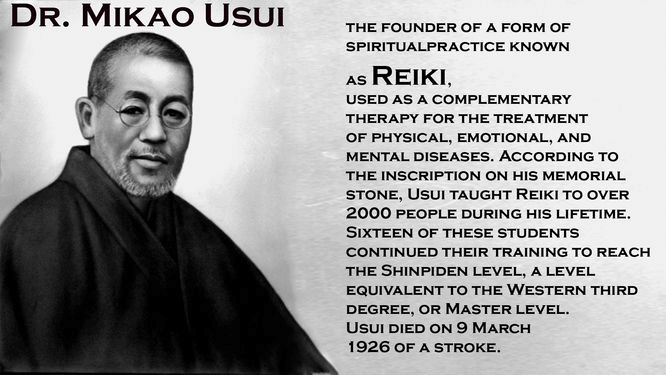
History of Usui Reiki
The origins of Usui Reiki trace back to the Meiji and Taisho periods in Japan. Its founder was Mikao Usui, who throughout his life sought deep peace and stability for body, mind, and spirit, a state known as “Anjin Ryumei” or “settling the heart and establishing one’s life purpose.”
Mikao Usui was born on August 15, 1865, in the village of Taniai (now part of Miyama-cho) in the Yamagata district of Gifu Prefecture, Japan, into a family with samurai ancestry that later became merchants. From a young age, he studied diligently and excelled beyond his peers. His intellectual pursuits were broad, encompassing Buddhist and Christian scriptures, traditional Chinese medicine, psychology, martial arts, history, divination, and physiognomy. He traveled extensively, including journeys to Europe, the United States, and China, in search of life’s deeper meaning, yet he encountered repeated setbacks and hardships. These experiences strengthened his resolve to cultivate himself and attain true inner stability free from worry and烦恼.
The Awakening Experience on Mount Kurama
By 1922, at nearly 57 years old, Mikao Usui decided to undertake rigorous ascetic practice. He chose the sacred Mount Kurama north of Kyoto. In late February or early March, he ascended the mountain and began a 21-day period of fasting and meditation, marking each day by placing and then discarding a small stone.
During these 21 days, his body grew progressively weaker, yet he sensed an increasing resonance between his internal energy and the universal energy. On the twenty-first night, a powerful beam of light suddenly penetrated the crown of his head. He felt as though struck by lightning and lost consciousness momentarily. Upon awakening, he experienced profound spiritual enlightenment and received the ability of “Great Reiki,” enabling him to heal others instantly. He named this system “Usui Reiki Ryoho” (Usui Reiki Healing Method). He immediately tested it on himself and his family members, with remarkable results.
This transformative event not only granted him healing power but also brought the realization of “I am the universe, and the universe is me.” From that moment, he no longer felt hunger or fatigue, truly achieving the state of Anjin Ryumei.
Establishment of the Five Principles
Mikao Usui grounded the practice of Reiki in five core principles, which serve as the daily foundation for every practitioner:
- Just for today, I will not worry.
- Just for today, I will not be angry.
- Just for today, I will be grateful.
- Just for today, I will do my work honestly.
- Just for today, I will be kind to every living thing.
These principles emphasize mental attitude adjustment, working together with energy healing to foster balance across body, mind, emotions, and spirit.
Founding of the Organization and Early Spread
Shortly after his awakening, in April 1922, Mikao Usui established the “Usui Reiki Ryoho Gakkai” (Usui Reiki Healing Method Society) in the Harajuku Aoyama area of Tokyo. This organization was dedicated to teaching Reiki and providing healing sessions. The society quickly attracted many students. He personally trained thousands of disciples, including key successors such as Chujiro Hayashi. Usui traveled widely across Japan to teach, and the Reiki method gradually gained popularity. It even received partial support from the Japanese Imperial Navy.
On March 9, 1926, while traveling to teach in Fukuyama, Mikao Usui suffered a cerebral hemorrhage and passed away at the age of 62 (some sources note 60). A memorial stone erected by his students in 1927 at Saihoji Temple in Tokyo records his life story and awakening experience.
Lineage Continuation and Asian Connections
The transmission of Usui Reiki strictly requires that each practitioner’s lineage be directly traceable back to Mikao Usui himself, thereby preserving authenticity. Chujiro Hayashi continued to develop the system and trained Hawayo Takata, who later introduced Reiki to the West, leading to its global spread. In recent years, certain organizations, including the Reiki Asia Board, have focused on safeguarding the Asian roots by bridging the Japanese Reiki tradition with South Asian energy medicine heritage, such as the chakra system and Ayurveda, viewing it as a connection between East Asian and South Asian healing legacies.
Reiki is fundamentally an energy-balancing technique rather than a religion or superstition. It combines universal wisdom (REI) with life force energy (KI, equivalent to qi in traditional Chinese medicine or prana in yoga), promoting smooth flow of vital energy to harmonize the physical body, mind, emotions, and spirituality. Its benefits include deep relaxation, pain relief, immune enhancement, trauma release, anxiety reduction, and support for spiritual growth. However, it is always positioned as a complementary healing modality and must never replace professional medical treatment.
Subsequent Developments and Considerations of Authenticity
After Mikao Usui’s passing, the original society continued to exist in Japan, where some groups still strictly preserve the early teachings. During its spread to the West, various styles and modifications emerged, resulting in inconsistencies in standards. Consequently, some Asian-based organizations emphasize returning to verifiable lineages and ethical guidelines.
Overall, the history of Usui Reiki is not merely the story of a healing technique’s birth but a profound journey of an individual seeking universal truth through rigorous self-cultivation. It reminds every practitioner that the essence of Reiki lies in pure intention and respect for all life, extending far beyond technical skills alone.